



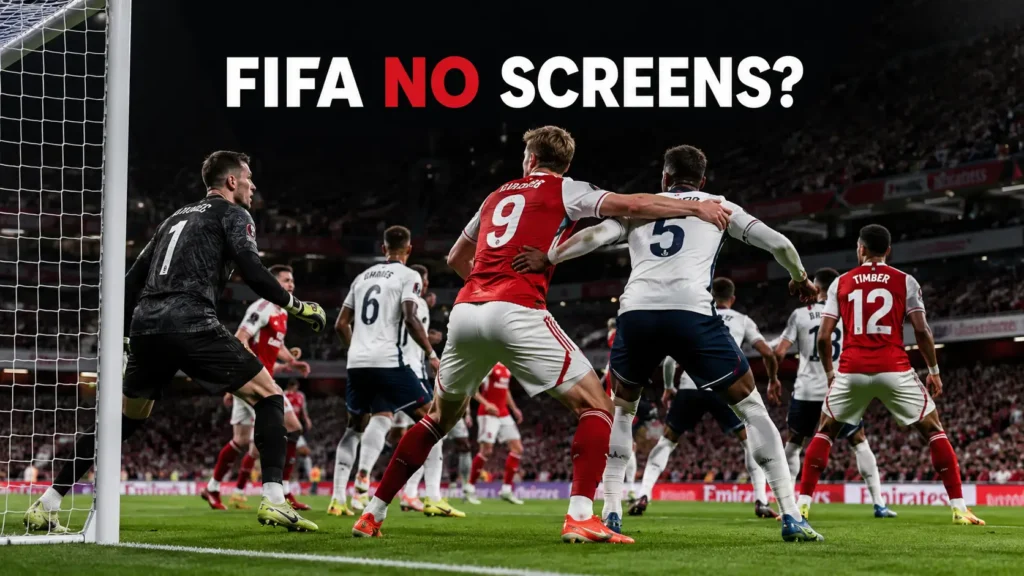
What Fans Need to Know:
FIFA no screens corner kicks has become one of the most talked-about phrases around the World Cup 2026 rule change, but many fans are still confused about what it really means. The new focus is not about banning normal contact at corner kicks — it is about stopping deliberate blocking before the ball is in play.
What FIFA is cracking down on is deliberate “screening” or blocking before the ball is in play — especially when an attacking player intentionally stops a defender or goalkeeper from moving. If that action directly affects a goal, penalty or disciplinary decision, VAR can now step in.
Football is no longer only about open-play magic. At the highest level, small tactical details can decide huge matches — and corner kicks are now one of the biggest weapons in the modern game.
That is why one World Cup 2026 rule change has created so much debate among fans, coaches and analysts: the crackdown on “screens” during set pieces.
Many supporters have seen the phrase “fifa no screens corner kicks” spreading online and wondered what it actually means. Are attacking players no longer allowed to stand near defenders? Can teams still block space? Will VAR start cancelling goals from corners?
The answer is more balanced than the headline suggests.
FIFA and IFAB are not removing the physical side of corner kicks. They are targeting deliberate off-the-ball blocks that unfairly stop defenders or goalkeepers from challenging for the ball.
A “screen” is a tactical blocking action borrowed from basketball language.
In basketball, a screen happens when one attacking player positions their body to block a defender, giving a teammate space to shoot, drive or receive the ball. Football has adapted a similar idea, especially on corner kicks and free kicks.
In football, a screen usually happens when an attacking player deliberately blocks a defender’s path so another teammate can run free.
For example, one attacker may stand still in front of a marker, stop a defender from tracking a runner, or block the goalkeeper’s movement inside the six-yard box.
The aim is simple: create space by preventing an opponent from moving.
Corner kicks have become highly planned routines.
Teams now use specialist set-piece coaches, coded signals, blocking runs and rehearsed movement patterns. Every player has a role, and sometimes that role is not to attack the ball — it is to create space for someone else.
That is where screens became controversial.
A clever screen can look like normal movement in a crowded penalty area. But when it becomes a deliberate block with no attempt to play the ball, it crosses into unfair obstruction.
That is the line officials are now expected to watch more closely at World Cup 2026.
The key point is simple: VAR can now review clear attacking-team offences that happen before the ball is in play at a corner kick or free kick.
This matters because many screens happen just before the ball is delivered.
A defender may be blocked half a second before the corner is kicked. A goalkeeper may be stopped from moving before the cross arrives. A runner may be freed because a teammate illegally blocks the marker.
Under the updated corner kick rules World Cup 2026, those actions are no longer easy to ignore.
If the referee decides that an attacking offence happened before the ball was in play, the correct restart is for the corner kick or free kick to be retaken.
Normal football contact is still allowed.
Players can still compete for space. They can still make runs across defenders. They can still stand their ground if they are already in a legal position.
A striker can attack the near post. A centre-back can start from the back of the penalty area and run toward the six-yard box. An attacker can move across a defender’s line as part of a genuine run to the ball.
Football remains physical, and corner kicks will still be crowded.
The important difference is intent and movement. Being in someone’s way is not automatically illegal. Moving into someone’s path just to block, hold, slow or obstruct them is where the problem begins.
The actions most likely to be punished are deliberate blocks or screens with no real attempt to play the ball.
That could include an attacking player standing still in front of a defender to prevent them from following a runner. It could be a player stepping across the goalkeeper’s path before the delivery. It could also be a teammate using arms, shoulders or body position to stop a defender from challenging.
If the action is clearly designed to block movement and it directly helps create a goal-scoring chance, referees and VAR now have stronger authority to intervene.
That is why the phrase “fifa no screens corner kicks” is partly true — but only if we understand it correctly.
Screens are not banned as a word. Illegal blocking is being targeted.
FIFA’s main reason is fairness.
Corner kicks should reward good delivery, smart movement and strong finishing. They should not reward a player who takes a defender out of the play before the ball is even kicked.
The crackdown also protects goalkeepers.
Goalkeepers are already vulnerable at corners. They must track the ball, judge the flight, deal with bodies around them and react in tight spaces. If attackers are allowed to deliberately block their movement before the delivery, the balance becomes unfair.
There is also a safety element.
Crowded penalty areas can easily turn into wrestling zones. Pulling, holding, shoulder-checking and off-the-ball collisions create dangerous situations, especially when players are jumping at full speed.
By regulating screens, FIFA wants to reduce chaos without killing the drama of set pieces.
Another reason is consistency.
Fans hate seeing one goal allowed and another ruled out for a similar action. Coaches hate preparing routines without knowing what referees will tolerate. Players hate uncertainty.
By clarifying the rule before the tournament, FIFA is trying to give referees, VAR officials and teams a clearer standard.
The goal is not to review every corner kick for tiny contact. The goal is to punish clear, deliberate offences that directly affect major outcomes.
Managers will likely give one clear message: do not make the referee’s decision easy.
If a player uses both arms, steps directly into a defender’s path, or clearly blocks the goalkeeper without playing the ball, the risk is high.
Teams can still be aggressive. But they must be aggressive within the rules.
At World Cup level, one disallowed goal can change a campaign. A small mistake on a corner routine could decide whether a team wins the group, reaches the knockout stage or goes home early.
That is why this World Cup 2026 rule change matters more than many fans realise.



Fresh football stories, match reactions, and tournament updates — delivered without the noise.







No Comments