


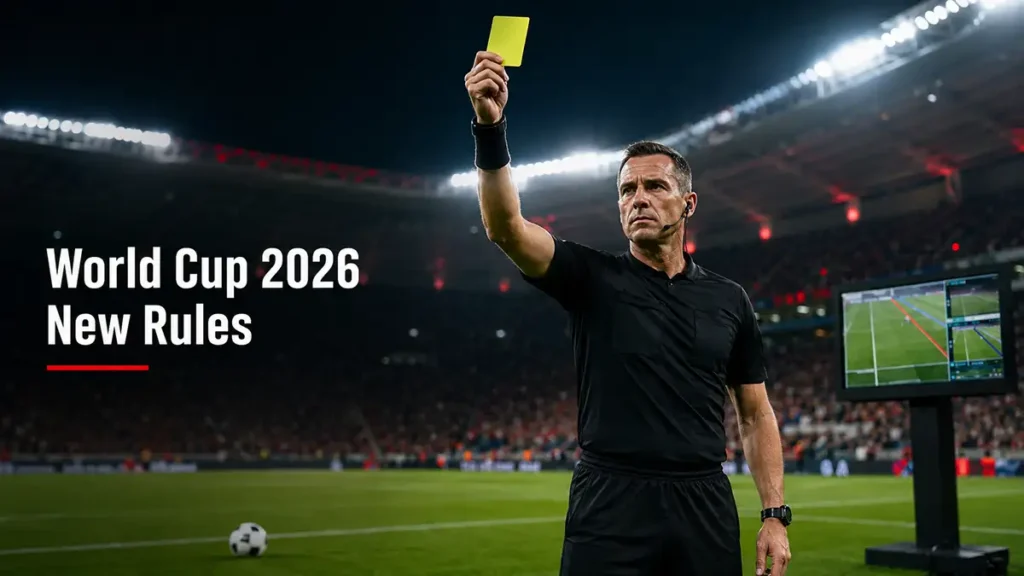
The FIFA World Cup 2026 is not only bringing more teams, more cities and more football drama. It is also bringing a sharper rulebook. Fans preparing for the biggest World Cup ever should pay close attention, because the World Cup 2026 new rules could affect red cards, VAR reviews, substitutions, injury stoppages, goal kicks, throw-ins and even the way players behave around referees.
This tournament is expected to be fast, intense and emotional. But FIFA and IFAB want it to be cleaner, quicker and harder to manipulate through time-wasting. For supporters, that means fewer slow restarts, more accountability and some big refereeing moments that could shape knockout matches.
Here are the main FIFA World Cup 2026 rules fans should understand before the tournament begins:
Every World Cup has its tactical story. Sometimes it is a new formation. Sometimes it is a new generation of stars. In 2026, one of the biggest stories could be match control.
The new football rules 2026 are designed to protect the rhythm of the game. Football has a time-wasting problem, especially late in matches when teams are protecting a narrow lead. A slow goal kick, a delayed throw-in, a substitution that takes too long, or a player staying down for treatment can all break momentum.
At the World Cup, those seconds feel bigger. One delayed restart can frustrate an entire stadium. One wrong card can change a group table. One incorrect corner can lead to a decisive goal.
That is why the World Cup 2026 rule changes are so important. They are not just technical details for referees. They could decide how teams manage pressure, how coaches use substitutions, how defenders handle set pieces and how players behave when emotions explode.
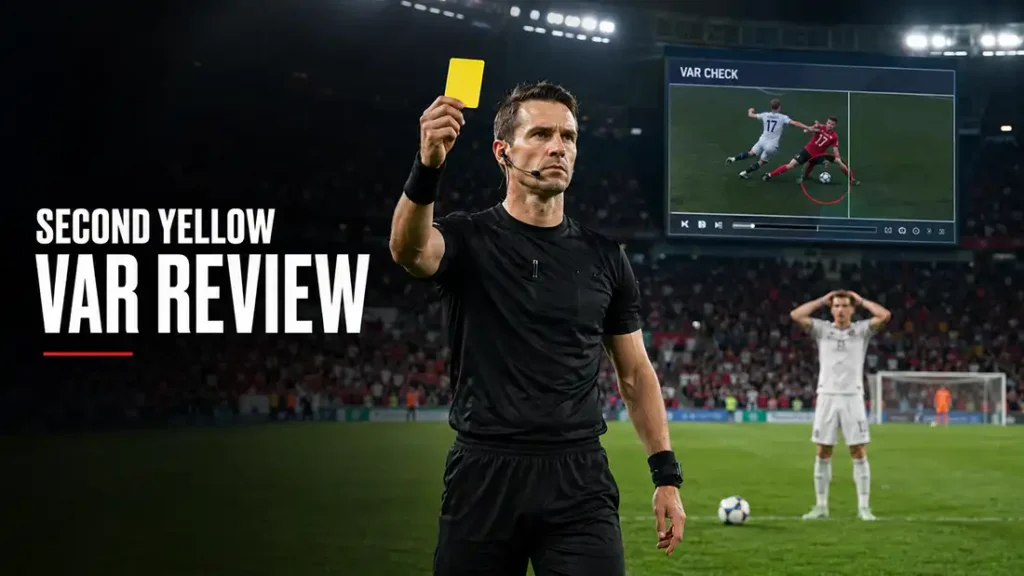
One of the biggest updates to the VAR World Cup 2026 system is the ability to review red cards that come from a clearly incorrect second yellow card.
Previously, VAR was mainly linked to goals, penalties, direct red cards and mistaken identity. A second yellow card was more complicated because a second caution creates a red card, but the individual yellow card itself was not normally treated in the same way as a straight red.
For the FIFA World Cup 2026 referee rules, this is a major shift.
If a player is sent off after receiving a second yellow card, and the second yellow is clearly wrong, VAR can now assist the referee. This does not mean VAR will check every yellow card. It does not mean VAR will search for possible second yellows that the referee missed.
The key phrase is clearly incorrect.
This matters because a second yellow can destroy a team’s match plan. Imagine a midfielder already on a booking, then receiving a second yellow for a challenge that replay shows was not a foul, or where the player clearly played the ball. Under the World Cup 2026 second yellow VAR update, officials have a clearer safety net for major, match-changing errors.
For fans, this could reduce the feeling that a World Cup match was ruined by one obvious mistake.
Another important part of the World Cup 2026 VAR rules is mistaken identity.
This is more straightforward. If the referee penalises an offence but shows the yellow or red card to the wrong player, VAR can help identify the correct player.
This matters because mistaken identity can create unfair suspensions, tactical confusion and major controversy. In a tournament where yellow-card accumulation can affect player availability, giving the card to the wrong player is not a small administrative error. It can affect a team’s next match.
Under the FIFA World Cup 2026 rules, VAR assistance can help protect the integrity of disciplinary decisions. The actual offence is not automatically opened up for a full re-trial unless it falls into another reviewable category. The focus is on correcting the identity of the player punished.
That is a smart, practical use of technology. It helps fix a clear error without turning every foul into a long video review.
One of the most interesting World Cup 2026 rule changes concerns corner kicks.
Competitions may allow VAR to review a clearly incorrectly awarded corner kick, but this is not meant to become a long debate over every deflection. The review must be possible immediately and without delaying the restart.
That detail is crucial.
If the corner is taken quickly, the decision cannot be changed. If the check is not immediately clear, the game should continue. This is a competition option and is designed for obvious mistakes only.
Why does this matter? Because corners can be massive moments in World Cup football. A wrong corner in the 89th minute can lead directly to a goal. In a knockout match, that could be the difference between going home and reaching the next round.
The challenge will be balance. Fans want big mistakes corrected, but nobody wants football to become stop-start. The best version of this rule is quick, factual and rare: clear error, fast correction, play continues.
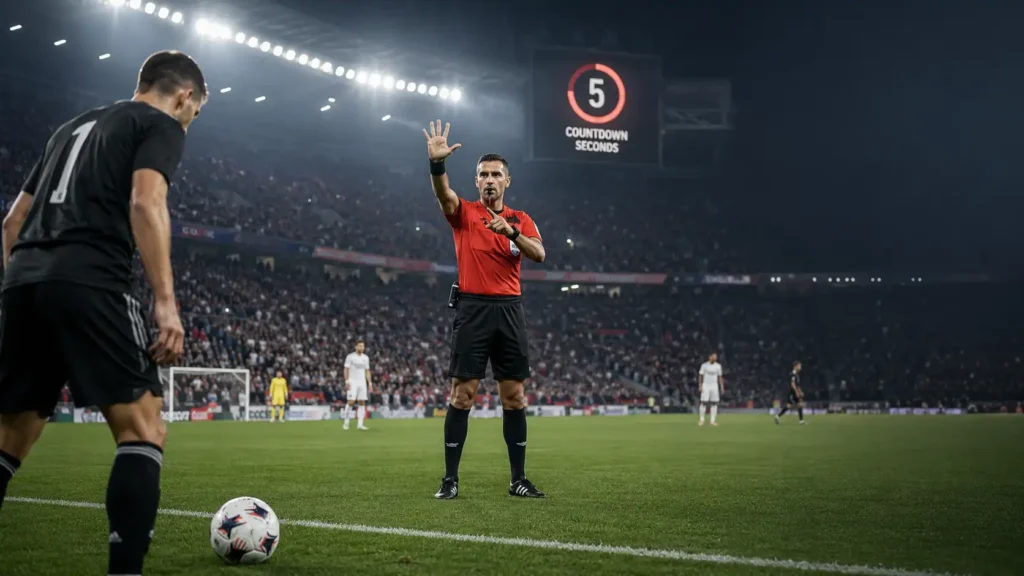
The World Cup 2026 goal kick countdown could become one of the most visible new rules for fans in the stadium and watching on TV.
If the referee believes a goal kick is taking too long or is being deliberately delayed, the referee can start a five-second visual countdown. If the goal kick is still not taken by the end of the countdown, a corner kick may be awarded to the opponent.
That is a serious punishment.
A delayed goal kick turning into a corner kick could completely change the final minutes of a match. Teams that try to slow the game down from the back will need to be careful. Goalkeepers, centre-backs and coaches will have to prepare faster restart routines.
This rule does not mean every goal kick must be taken instantly. The referee still judges when the delay becomes unfair or deliberate. But once the countdown begins, the message is clear: restart the game, or lose the restart.
For teams defending a lead, this creates pressure. For teams chasing a goal, it creates hope. The crowd will see the countdown, feel the tension and react loudly.
The World Cup 2026 throw in countdown follows the same idea.
If a team delays a throw-in, the referee can whistle, signal for the throw-in to be taken and start a visible five-second countdown. If the throw-in is not taken before the countdown ends, the throw-in can be awarded to the opposing team.
This could be very important in tight games.
Throw-ins are often used to slow matches down. Players walk slowly to the ball, swap throw-in takers, wait for teammates to move, then delay again. At the World Cup, that routine may be punished more quickly.
This rule should help improve match tempo. It also puts more responsibility on players to know their options before they receive the ball for a throw-in.
Expect teams to train this. Full-backs, wingers and midfielders will need faster movement. Coaches may also prepare specific throw-in patterns so players are not wasting time deciding where to go.
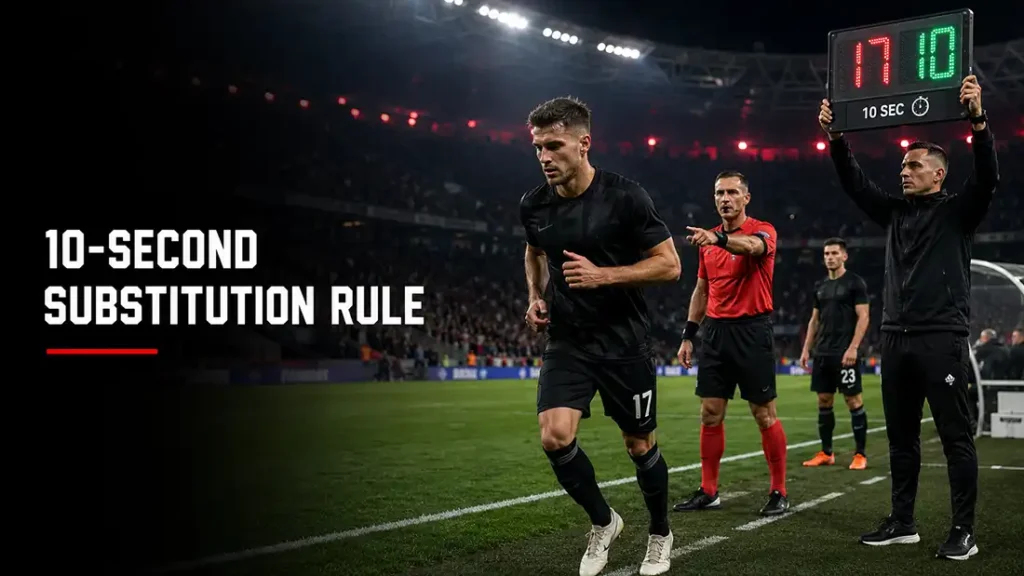
The World Cup 2026 substitution rules include a new time-limited substitution process.
When the substitution board is shown, or when the referee gives the signal where no board is used, the substituted player must leave the field quickly. The key timing is 10 seconds.
If the player does not leave within that time, the player must still exit, but the substitute may not be allowed to enter until the first stoppage after one minute of running-clock play has passed following the restart.
This is a clever anti-time-wasting rule because it affects the team trying to delay.
In the past, a player coming off could slowly walk across the pitch, applaud the crowd, hug teammates and waste precious seconds. Now, that behaviour could hurt their own team by delaying the replacement’s entry.
For coaches, this changes substitution management. Players must know where to exit. Teams must communicate clearly. Late defensive substitutions will need discipline because a slow exit could leave the team temporarily short of the fresh player they wanted.
For fans, it should make substitutions faster and reduce one of the most frustrating forms of stoppage-time delay.
Another major update concerns injuries and on-field treatment.
If a player receives on-field assessment or treatment, or if the injury causes play to stop or delays the restart, the player may be required to leave the pitch and only re-enter one minute after play has restarted.
There are exceptions. The rule does not apply in the same way when a goalkeeper is injured, when a goalkeeper and outfield player collide and need attention, when players from the same team collide, when a severe injury occurs, when a player is injured by an offence for which the opponent is cautioned or sent off and the treatment is completed quickly, or when a penalty is awarded and the injured player will take it.
This World Cup 2026 off-field treatment rule is designed to stop tactical injury delays while still protecting player safety.
That balance is important. Football must never punish genuine serious injuries. But it also cannot allow players to stop the game repeatedly with minor treatment delays when their team is under pressure.
In the 2026 World Cup, referees and medical teams will be under the spotlight. The rule could discourage players from going down too easily, especially late in matches.
FIFA and IFAB are clearly focused on player behaviour. The aim is not only to punish time-wasting. It is to protect referees, reduce chaos and keep the match moving.
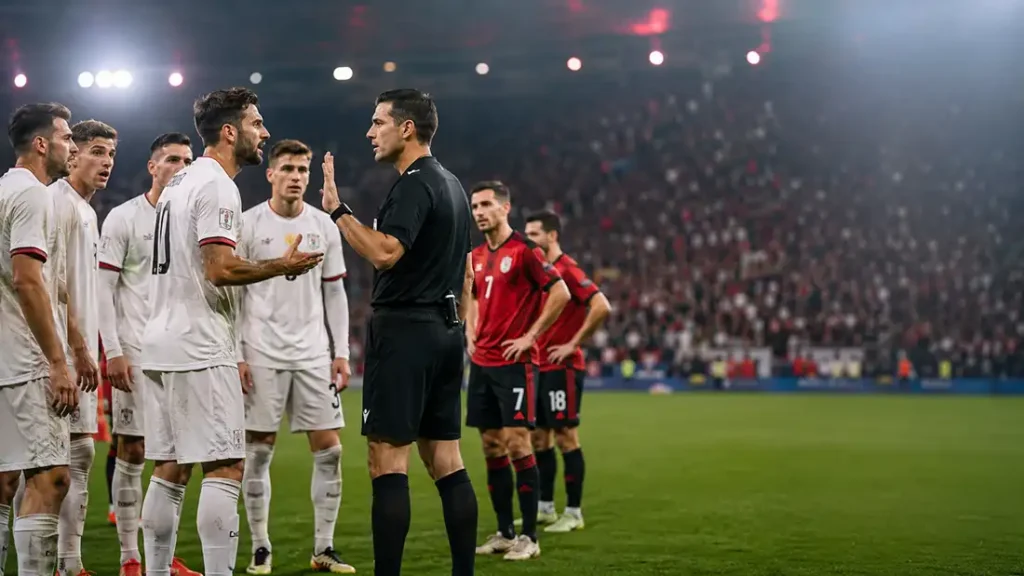
This matters because World Cup games are emotional. Players are representing countries. Coaches are under pressure. Every decision feels huge. When players surround referees, argue aggressively or delay restarts, the match can lose control.
The FIFA World Cup 2026 referee rules are part of a bigger direction in football: more respect, clearer communication and less disruption.
Fans should expect referees to be alert to dissent, protests and behaviour that delays the game. Captains may become even more important as the main communication bridge between players and officials.
For teams, discipline will be a competitive advantage. The smartest sides will not only have tactical quality. They will stay calm when big decisions go against them.
This topic needs careful explanation.
Mouth-covering during confrontations has been mentioned in official IFAB/FIFA communications as an issue for consultation. It is linked to the wider focus on player behaviour and possible measures around confrontations between players.
However, unless FIFA or IFAB officially confirms it as a final tournament rule, it should not be presented as fully approved.
So the responsible position is this: mouth-covering during confrontations is being discussed as part of the effort to address behaviour and accountability, but fans should wait for official confirmation before treating it as a guaranteed red-card offence or fixed disciplinary rule.
That distinction matters. ExtraTime24 should not present consultation topics as confirmed laws. The confirmed rules are the approved VAR changes, countdown measures, time-limited substitutions and off-field treatment protocol.
The World Cup is where small details become history.
A five-second countdown on a goal kick could create a corner in stoppage time. A quick VAR correction on a second yellow could keep a star player on the pitch. A slow substitution could leave a team waiting for its replacement. A player treated on the field could be forced to stay off for one minute while the opponent attacks.
These are not small rulebook footnotes. They are match scenarios.
In knockout football, game management is everything. Teams often protect narrow leads by slowing the tempo. The World Cup 2026 time wasting rules make that strategy riskier.
This could benefit attacking teams. If a losing side is pushing late, the opponent will have fewer easy ways to kill rhythm. Restarts should be quicker. Substitutions should be cleaner. Injury delays should be harder to exploit.
But it also creates pressure on referees. They must apply the rules consistently. A countdown in one match and no countdown in a similar moment in another match will create debate. Consistency will be key.
These rule changes will also make tournament predictions even more interesting. A team’s path in 2026 will not depend only on star power, tactics, and squad depth, but also on discipline, quick restarts, and how well players adapt to the new match-flow rules. For a wider look at the teams, dark horses, and possible tournament scenarios, read our full 2026 World Cup predictions guide.
Fans watching the FIFA World Cup 2026 should keep an eye on several details.
First, watch the referee’s hand during goal kicks and throw-ins. If the referee raises a hand and starts counting down, the team in possession is under pressure.
Second, watch substitutions late in matches. Players leaving slowly may no longer be helping their team. They may be delaying their own replacement.
Third, watch VAR communication after red cards caused by second yellow cards. If the second caution appears clearly wrong, VAR may now become involved.
Fourth, watch injury stoppages. If a player receives treatment on the pitch, they may have to leave and stay off for a minute after play restarts unless an exception applies.
Finally, watch team discipline. The World Cup 2026 new rules reward teams that stay organised, restart quickly and avoid unnecessary confrontation.
The best World Cup matches have rhythm. They have pressure, transitions, fast restarts and emotional momentum. Time-wasting damages that rhythm.
The new rules are clearly aimed at giving football back some of its flow. Instead of adding more complicated tactical layers, they focus on simple ideas:
Restart faster. Leave the pitch quicker. Do not misuse injury treatment. Correct obvious VAR mistakes. Respect the referee.
That should help fans enjoy more actual football.
Of course, the rules will only work if applied well. Referees must be clear. Players must understand the limits. Broadcasters must explain what is happening. Supporters must know the difference between confirmed rules and consultation topics.
If everything is communicated properly, the 2026 World Cup could feel faster, cleaner and more transparent.
For official details, FIFA published the IFAB announcement explaining the approved measures to improve match flow and player behaviour, including VAR protocol updates, five-second countdowns for delayed restarts, time-limited substitutions, and the off-field treatment rule. Fans can read the official update here: IFAB introduces further measures to improve match flow and player behaviour.
The main World Cup 2026 new rules include expanded VAR help for clearly incorrect second-yellow red cards, mistaken identity reviews, optional quick checks for clearly wrong corner-kick decisions, five-second countdowns for delayed goal kicks and throw-ins, 10-second substitution exits, and a one-minute off-field treatment rule for certain injury situations.
VAR can assist when a red card comes from a clearly incorrect second yellow card. This does not mean every yellow card will be reviewed. The focus is on clear errors that lead to a sending-off.
If the referee believes a goal kick is being unfairly delayed, the referee can start a five-second visual countdown. If the goal kick is not taken before the countdown ends, the opposing team may be awarded a corner kick.
If a throw-in is being delayed, the referee can signal for it to be taken and start a five-second countdown. If the throw-in is still not taken, it can be awarded to the opposing team.
Based on official IFAB/FIFA wording, mouth-covering during confrontations has been mentioned as a consultation topic. It should not be described as a fully confirmed rule unless FIFA or IFAB officially confirms it.
The FIFA World Cup 2026 is already historic because of its size, host nations and global excitement. But the rule changes could make it even more fascinating.
The World Cup 2026 new rules are designed to protect match flow, reduce time-wasting, improve player behaviour and give VAR a better chance to correct rare but serious mistakes. For fans, that means more football, fewer delays and potentially fewer matches decided by obvious officiating errors.
Teams that adapt quickly will have an edge. Players who stay calm will help their countries. Referees who communicate clearly will shape the tournament’s rhythm.







No Comments